

Sped up, Slowed down, Extended, Chopped & Screwed, Clean, Explicit and Acapella versions, alternate cover editions and more; it seems like organic hits are a thing of the past.
In today’s music industry, the concept of organic hits seems increasingly elusive as artists fervently chase statistics and chart positions. This relentless pursuit often results in a proliferation of song variations—sped up, slowed down, extended, chopped & screwed, clean, explicit, and acapella versions—alongside alternate cover editions, all in an attempt to bolster streaming numbers and climb the charts.
However, one could argue that this strategy caters more to the desires of fans rather than serving as a genuine measure of success or a hit. It’s perplexing to comprehend how artists can perceive achieving higher chart positions through manipulation, such as releasing numerous versions of a song, as a genuine representation of their artistry and talent.
In reality, this approach seems to dilute the authenticity of their music rollout, detracting from the core essence of their creative expression. By prioritizing chart success through such means, artists risk sacrificing the integrity of their work in favor of chasing fleeting metrics.
Instead of nurturing genuine artistic expression, this trend contributes to the commodification of music, reducing it to a mere product to be packaged and sold rather than a medium for authentic self-expression and connection with audiences.
While it’s undeniable that platforms like TikTok have revolutionized the way we consume music, it’s disheartening to witness labels compromising the aesthetics and rollout strategies of their artists by succumbing to trends like sped up and slowed down songs.
These trends only feel genuinely organic when they originate from users themselves. Case in point, examples such as Escapism or Prada by Raye demonstrate the power of organic trends. The remixes of her songs crafted by fans propelled her career to superstardom. However, when other artists attempt to replicate this success by manufacturing similar trends, it comes across as inauthentic and contrived.
It’s crucial for labels and artists alike to recognize the distinction between genuine user-driven trends and manufactured attempts to chase viral success.
The influence of sped-up music trends has transcended online platforms and infiltrated mainstream media. A recent example of this trend ocurred when the remix of Lady Gaga’s song “Bloody Mary,” which was trending at the time of filming, was featured as a lipsync song in RuPaul’s Drag Race season 16.
The decision to use the sped-up version sparked a frenzy among fans and alumni of the franchise.
The backlash to this sped-up remix prompts a crucial reflection on the nature of trends. It begs the question: do these sped-up/slowed-down remix trends only have value where they originated, and can they only be appreciated when organic rather than manufactured or exploited for every ounce of their value?
This serves as a reminder that authenticity and integrity should be preserved in the cultivation and dissemination of trends and while it’s undeniable that trends can shape cultural landscapes and drive artistic visibility, their essence often lies in their spontaneous emergence.
In conclusion, there’s merit in allowing trends to exist in their natural habitat rather than attempting to harness or manipulate them for commercial gain.
Despite the recognition of the importance of preserving the organic nature of trends, it seems unlikely that the exploitation or manufacturing of sped-up trends will cease anytime soon. Labels have been actively engaging in efforts to promote officially released sped-up remixes on streaming services.
For instance, Universal Music Group (UMG) launched the Spotify account Speed Radio, dedicated to showcasing its sped-up tracks, which currently boasts more than 6 million monthly listeners. Similarly, Warner Music Group utilizes the account Sped Up Nightcore to promote its releases, amassing an impressive audience of over 10 million listeners.
These initiatives highlight the industry’s keen interest in capitalizing on the popularity of sped-up trends, suggesting that such practices are here to stay.
Case study: Billboard Hot 100 Top 10 chart – Week of March 23rd 2024
In this case study, I aimed to devise an “Organic Hit Score” for this week’s Billboard Top 100 chart, focusing on three key factors: the number of versions of each single, the duration of its chart presence, and its placement on the chart.
The Organic Hit Score aims to provide insight into the genuine impact and popularity of singles, considering factors beyond mere chart position. Through this analysis, I aimed to shed light on the nuanced dynamics influencing the music industry landscape, highlighting the significance of authenticity and longevity in determining true hits.
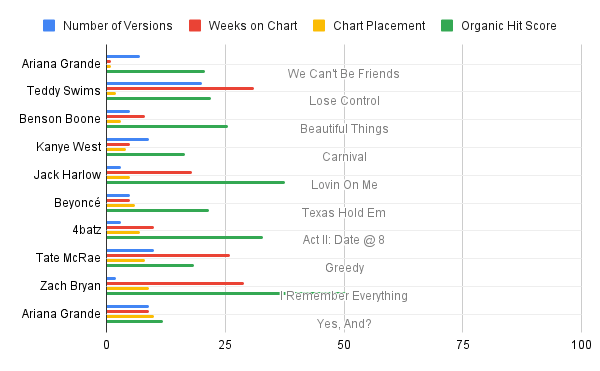
By assigning a weight of 0.8 to the “Number of Versions” column, 0.1 to the “Weeks on Chart” column, and 0.1 to the “Chart Position” column, we establish a framework for calculating the Organic Hit Score. This weighted approach allows us to discern the relative importance of each factor in determining the authenticity and impact of a song’s success. By analyzing these components together, we can generate a comprehensive Organic Hit Score that identifies which songs resonate more authentically with audiences and possess greater organic appeal compared to others on the Billboard Top 100 chart.
From this analysis, it becomes evident that Jack Harlow’s “Lovin On Me” with only three versions, and Zach Bryan’s “I Remeber Everything” emerge as the most significant organic hits on the chart, with scores of 37 and 50 respectively. In contrast, tracks like “Lose Control” by Teddy Swims or “Greedy” by Tate McRae, with 20 and 10 versions, respectively, struggle to achieve high Organic Hit Score despite charting for over 25 weeks.
Despite concerns regarding chart padding or manipulation, it’s clear that organic hits continue to hold their ground when the influence of artificial tactics is stripped away.
 Brad M | Media
Leave a comment